Security, Depth and Compassion: The Brain's Three Emotional Circuits
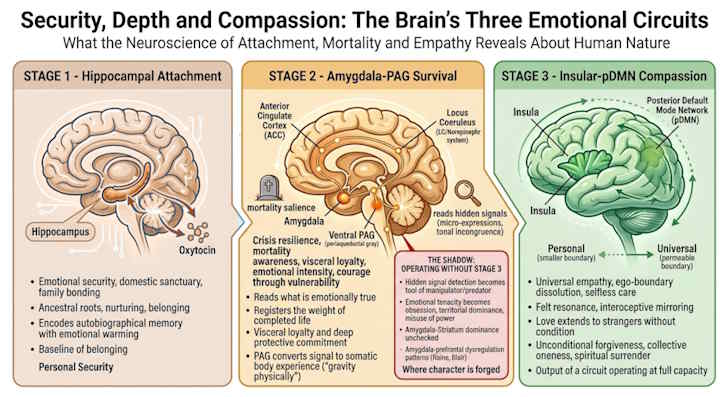
Most people think of emotions as a single thing - you feel, or you don't. Neuroscience reveals something far more precise: three distinct neural circuits, each with its own architecture, its own function, and its own stage in the progression from personal security to universal compassion. By examining the specific neural hubs that govern these three stages, we can map the exact biological machinery behind emotional security, crisis-driven transformation, and transcendent empathy.
Stage 1 - Hippocampal Attachment
Emotional security, domestic sanctuary, family bonding, ancestral roots, nurturing, belonging.
The hippocampus helps give our emotional life its personal history. Not abstractly - it is the smell of your mother's kitchen, the sound of a familiar voice, the feeling of being home. The hippocampus encodes autobiographical memory with emotional coloring, and when oxytocin - the bonding neurochemical - is present, those memories are encoded more deeply and recalled with greater warmth.This is the circuit of attachment: family, ancestry, private sanctuary, the sense of being known and loved. Without this foundation, nothing above it is possible. You cannot extend care to the world if you have never felt secure within your own walls. The hippocampus provides the baseline of what it feels like to belong.
Stage 2 - Amygdala-PAG Survival
Crisis resilience, mortality awareness, visceral loyalty, emotional intensity, courage through vulnerability
Stand at a gravestone. Something happens in that moment that no purely intellectual experience can produce.
The amygdala reads what is real. Not what is stated, not what is socially comfortable - what is emotionally true. At a cemetery it registers the weight of a completed life: the irreversibility, the preciousness, the fact that every moment counted. This is not fear. This is mortality salience - the amygdala recognizing the existential stakes of being alive.
The ventral PAG (periaqueductal gray) translates this recognition into the body. You feel the gravity physically. This brainstem region helps translate powerful emotions into physical responses, including the instinct to protect ourselves and those we love.
The amygdala carries two additional capacities most people overlook.
It detects hidden signals. While the analytical brain reads what is said, the amygdala reads what is withheld - micro-expressions, tonal incongruence, the gap between words and emotional truth. This is the investigator function: going beneath the surface not by logic but by felt recognition.
And it sustains. Through its connections to the anterior cingulate cortex and the locus coeruleus (the brain's norepinephrine system), the amygdala maintains emotional states with a tenacity that will not release until resolution arrives. Visceral loyalty. Deep protective commitment. The refusal to surface until the truth is found.
These same capacities carry a shadow. The hidden-signal detection that serves a healer also serves a predator.
The ability to read what is withheld becomes the tool of the manipulator - reading vulnerabilities to exploit rather than protect. Emotional tenacity without compassion to redirect it becomes obsession, territorial dominance, and the misuse of power. Research on violent offenders and individuals with callous-unemotional traits (Raine, Blair) documents specific amygdala-prefrontal dysregulation patterns - the amygdala-striatum dominance pathway, unchecked, turns the pursuit of power into its own reward. When Stage 2 operates without Stage 3, depth becomes control and loyalty becomes cruelty. Stage 2 is where character is forged. Security tells you who you love. Depth tells you what you will do for them - and the direction that power takes is the measure of the human being.
Stage 3 - Insular-pDMN Compassion
Universal empathy, ego-boundary dissolution, selfless care, and forgiveness. The insula reads the body's internal state and maps it onto others. Not through inference or through logic but through felt resonance.
When you witness someone in pain, the insula activates as if the pain were your own. This is one of the remarkable features of empathy: another person's suffering can produce a genuine emotional response within our own body. .
The posterior default mode network (pDMN), working with the insula, allows the boundary of self to become permeable. What was personal becomes universal. The love encoded in the hippocampus for your family - the insula now extends to strangers. Empathy and forgiveness are not merely abstract ideals. They involve real emotional processes supported by interconnected networks in the brain.
These three emotional circuits can operate independently, but they can also interact and reinforce one another. The progression from security through emotional depth to compassion is one possible pathway, not a necessary sequence. Hippocampal attachment establishes the emotional baseline without which the amygdala has nothing worth protecting. The amygdala-PAG transformation produces the depth without which the insula's compassion remains shallow. And the insula's transcendence provides the moral direction. Without this integration, the circuits fail:
Security without depth stays tribal. Depth that does not extend to others becomes obsession. Compassion without roots has nothing real to care for.
The amygdala responds to the emotional significance of loss. The hippocampus retrieves memories of the person and the security of family life. The insula contributes to the bodily experience of grief and awareness of vulnerability.
That experience may awaken a desire to return home, embrace one's children, or extend greater compassion to others.
Mortality reminds us of attachment. Attachment gives meaning to loss. And the recognition of shared vulnerability can deepen compassion.
Human emotional development follows this exact neurobiological sequence. We begin by establishing a secure hippocampal memory baseline. We are transformed when our amygdalar circuits confront the reality of mortality and loss. Finally, our insular and default mode networks dissolve our internal boundaries, allowing us to experience true, unconditioned empathy for the human condition.