The Neural Architecture of Achievement: How the Brain Automates, Calibrates, and Pursues Goals
Most discussions of execution focus on abstract concepts like "mindset" or "grit."
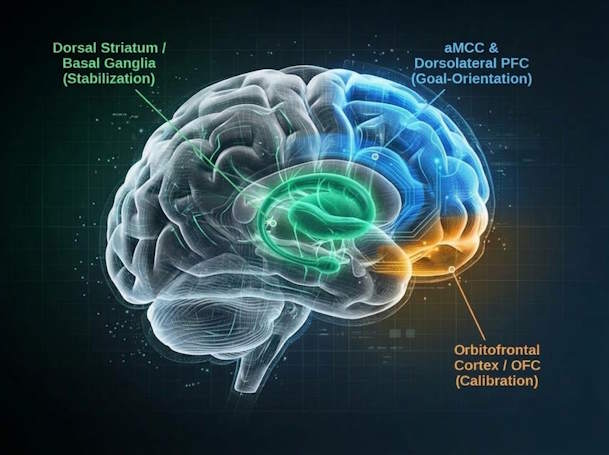
Sustainable execution requires stabilization, calibration, and goal-orientation: reliable routines, correction through feedback, and sustained effort toward demanding goals. These capacities draw on interacting striatal, orbitofrontal, cingulate, and prefrontal systems.
When aligned, these networks operate in parallel to translate long-range vision into durable reality.
Stabilization: Dorsal Striatum and Basal Ganglia
Before high-level strategy can take root, an organism must conserve metabolic energy. The brain consumes roughly 20% of the body's glucose, and deliberating over every micro-decision induces rapid cognitive fatigue.
This is where the dorsal striatum (specifically the caudate and putamen within the basal ganglia) performs its primary computational function: sensorimotor consolidation and routine automation.
- Procedural Memory: With deliberate practice, execution becomes less dependent on conscious prefrontal control and increasingly supported by habit-related corticostriatal circuits. What begins as an exhausting manual effort settles into an automated, reliable operational cadence.
- Conservation of Capital: By locking in dependable operational rhythms, this subcortical circuit preserves precious prefrontal bandwidth for unexpected crises. It provides the grounding infrastructure: the unwavering physiological and procedural baseline that resists external disruption.
- Operational Permanence: This network prioritizes familiarity, repetition, and predictability. By automating the foundational tasks, it ensures that existing assets, workflows, and core competencies remain protected, stabilized, and functional day after day.
A system without robust striatal automation collapses under decision fatigue, constantly forced to reinvent its basic operations every morning.
Calibration: Orbitofrontal Cortex
Automation alone is dangerous if the underlying process is flawed. To maintain operational precision, the brain recruits the orbitofrontal cortex (OFC) to run real-time quality control.
The OFC sits at the intersection of sensory processing, memory, and reward evaluation, acting as a crucial optimization hub:
- Expected Outcome Evaluation: The OFC actively represents specific expected outcomes and compares them directly against real-world sensory data. When actual results deviate from expectations, the OFC flags the discrepancy and prompts the system to adjust behavior.
- Iterative Refinement: Rather than relying on rigid assumptions, the OFC updates value representations dynamically. In practical execution, this is the biological foundation of craftsmanship: the persistent drive to adjust a variable, clean an anomaly, streamline a workflow, or polish a detail based on live feedback.
- Discrimination and Nuance: By tracking nuanced changes in reward values, costs, and environmental conditions, the OFC assesses whether an output is truly functional or merely passable, driving continuous operational hygiene.
Without OFC-driven calibration, organizations and individuals double down on obsolete habits, mistaking repetitive motion for actual progress.
Goal-Orientation: aMCC and Dorsolateral PFC
Mastery requires moving through systemic friction, pain points, and delayed gratification. This demands a critical executive pairing: the anterior midcingulate cortex (aMCC) and the dorsolateral prefrontal cortex (dlPFC).
This circuit provides the structural architecture for long-range achievement:
- Effort Cost Calculation (aMCC): Neuroscience identifies the aMCC as a key node for sustained effort: the conscious decision to push through physical, cognitive, or emotional friction when an immediate reward is absent. It calculates whether the long-term objective justifies the energetic tax and mobilizes the motor systems to act anyway.
- Hierarchical Structuring (dlPFC): The dlPFC maintains temporal orientation across time. It suppresses short-term impulses, organizes multi-stage roadmaps, and coordinates the step-by-step logic required to build complex institutional structures over years rather than days.
- Delayed Payoff: This network supports the pursuit of accumulated, compound value over transient rewards. It thrives in high-responsibility environments, reinforcing accountability, structural resilience, and uncompromising long-term execution.
Without the aMCC and dlPFC, ideas remain theoretical, unable to survive the prolonged uphill climb required to scale.
Three Capacities Working Together
High performance is not a singular trait. It is the coordinated activity of these three capacities operating concurrently:
- Stabilization (Dorsal Striatum / Basal Ganglia): Anchors operational baselines, automates repeatable routines, and protects metabolic bandwidth.
- Calibration (Orbitofrontal Cortex): Evaluates real-world outcomes against expectations, driving continuous refinement and craftsmanship.
- Goal-Orientation (aMCC + Dorsolateral PFC): Supports effort allocation, multi-stage planning, and sustained pursuit of long-term objectives despite obstacles.
The dlPFC and aMCC map the summit and absorb the initial cost of the climb; the OFC inspects each foothold and corrects course; and the dorsal striatum turns successful steps into automated muscle memory so the progress can be sustained indefinitely.
When execution breaks down, it is rarely a vague failure of motivation. Instead, it points to a specific breakdown across three practical dimensions:
- Are your routines reliable? If foundational tasks consume daily cognitive debate, your striatal automation is unanchored.
- Is feedback changing your behavior? If error drift continues uncorrected, your orbitofrontal calibration is offline.
- Is your effort sustainable? If friction causes projects to stall before compounding occurs, your goal-directed planning and effort may need adjustment.
Execution is an architectural reality. Identify which of these three nodes is bottlenecking the system, repair the interface, and sustained mastery follows naturally.