Beyond Symptom Management: A Tri-Axial Neural Framework for Overcoming Systemic Apathy
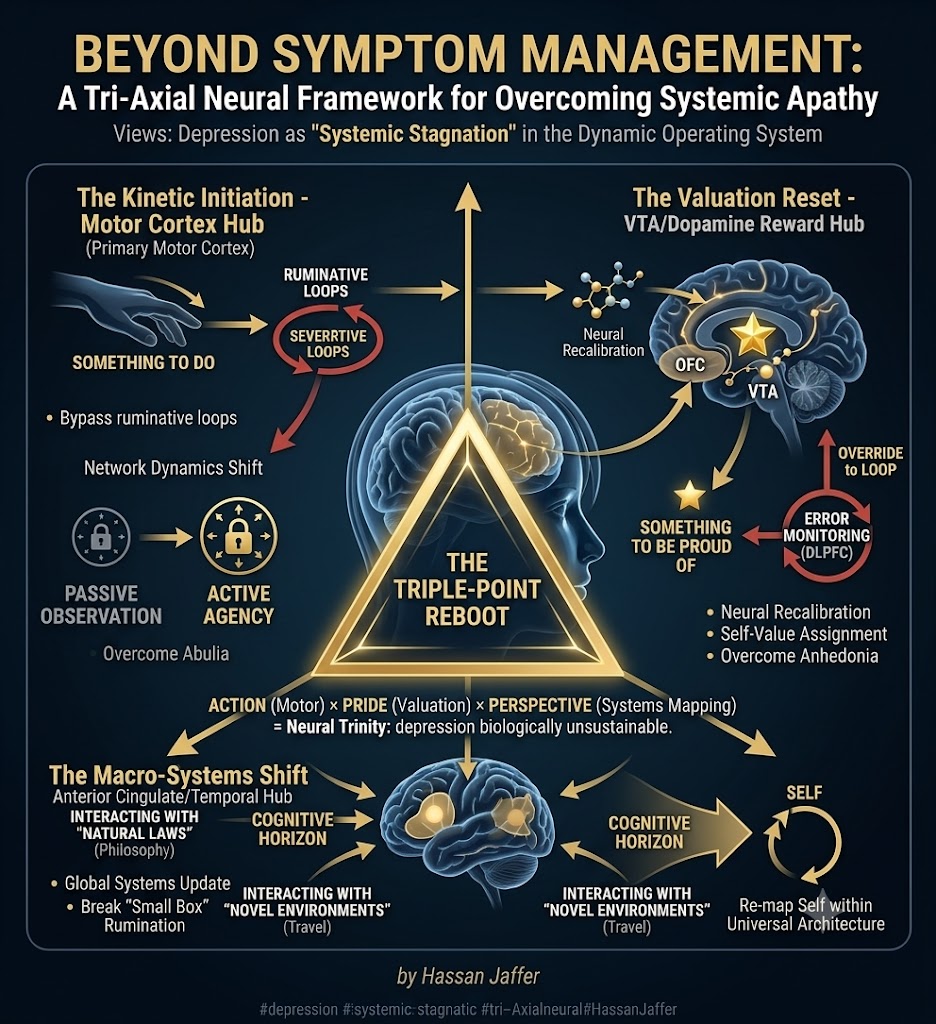
For too long, the clinical approach to depression has focused on chemical suppression. However, if we view the brain as a Dynamic Operating System, depression is more accurately described as a "Systemic Stagnation" across three specific neural domains.
To reboot a stagnant neural architecture, we must move beyond "talk therapy" and engage three specific functional hubs:
The primary hallmark of depression is Abulia - the inability to initiate action.
By engaging the Primary Motor Cortex through "something to do," we bypass the ruminative loops of the prefrontal cortex.
Physical initiation forces a shift in large-scale network dynamics, moving the brain from a state of passive observation to Active Agency.
Anhedonia (the loss of pleasure) is a failure of the brain's internal Valuation System.
Achieving "something to be proud of" triggers a localized release of dopamine in the Ventral Tegmental Area (VTA).
This isn't just "feeling good"; it is a Neural Recalibration. It forces the brain to assign value back to the self, overriding the "Error Monitoring" (DLPFC) that usually fuels self-criticism.
Depression narrows the "Cognitive Horizon" to a small, painful loop of self. The antidote is any genuine encounter with something of real magnitude.
Interacting with foreign people, foreign cultures, and foreign perspectives directly activates the Temporoparietal Junction - the brain's dedicated processor for minds that carry a fundamentally different reality than your own. Their wisdom, their worldview, and their way of seeing opens a door the isolated mind cannot open alone. Philosophy, natural laws, and any encounter with divine order engage the temporal lobe's capacity for transcendent recognition. The ACC sustains the open attention required for these experiences to fully land.
The output is Hope - not as a sentiment, but as a neural recalibration. The temporal lobe recognizes that the universe is not random or indifferent. It re-maps the self within a design that is larger than personal circumstance. A mind that has genuinely encountered something vast - a foreign wisdom, a natural law, a moment of divine recognition - cannot sustain the "Small Box" of depression. The system updates. The horizon expands.
When we align Action (Motor), Pride (Valuation), and Perspective (Systems Mapping), we create a "Neural Trinity" that makes depression biologically unsustainable.
We are not treating a "disease"; we are optimizing an Operating System.