Cognitive Styles & Architectural Logic
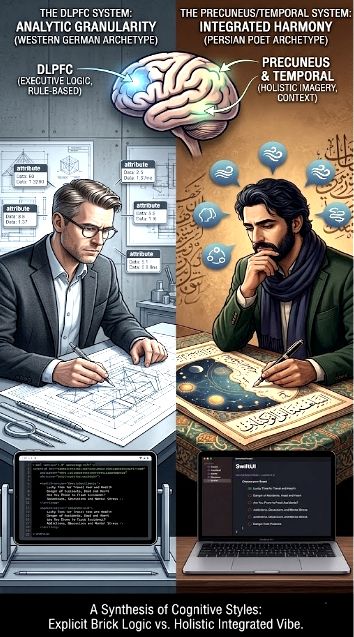
It is interesting how different brain regions mirror the stark contrast between the micro-management of Android XML and the holistic harmony of SwiftUI. As promised, here is Part 2, where we break down the specific regional cultural logics and the neurological clash between these two environments.
Analytic Logic: Focus on Individual Objects
In this cultural paradigm, the dominant cognitive approach is highly analytic, focusing on the precision and definition of individual objects. This mirrors the activity of the Dorsolateral Prefrontal Cortex (DLPFC), which excels at rule-based systems, executive function, and granular logic.
In the realm of technology, this translates perfectly to Android XML. Just as the culture values explicit rules and individual responsibility, Android XML requires an object-by-object declaration, where every attribute of every element must be explicitly defined to ensure total control and predictability within the system.
Holistic Logic: Focus on Relationships and Context
This perspective emphasizes a holistic worldview, where the focus lies on the relationships and the broader context rather than isolated components. Neurologically, this is associated with the Precuneus and Temporal regions, areas of the brain involved in mental imagery, self-context, and sensory synthesis.
This architectural philosophy is best represented by SwiftUI. These systems utilize inherited styles and grouping, allowing the designer to define a "vibe" or a master rule that flows through the entire group, prioritizing the harmony of the "Gestalt" over the micro-management of individual parts.
Integrative Logic: Bridging Control and Intent
When we look at the conflict between different programming environments, we are often witnessing a clash between these two cognitive styles.
The frustration a designer feels when moving from a holistic system (like Xcode) to an analytic one (like Android) is essentially the brain's Precuneus seeking harmony while being forced into the rigid, rule-bound labor of the DLPFC.
Understanding these cultural and neurological roots helps explain why certain languages feel intuitive to some and "hodgepodge" to others - it is a reflection of whether the code prioritizes the individual brick or the architecture of the entire building.
As we move toward a more globalized digital world, should we be building tools that demand Granularity (DLPFC) or tools that facilitate Harmony (Precuneus)?