Beyond DSM-5: Introducing the 144-Phenotype Neuroscience Framework
I'm sharing an early framework from my book that explores a shift from symptom-based diagnosis toward brain-system-level mapping.
The Limitation of DSM-5
The limitation of DSM-5 is not intent, but resolution:
- Primarily descriptive rather than mechanistic
- High rates of artificial comorbidity
- Limited accommodation of individual neural variation
- Weak linkage to identifiable brain systems
The 144-Phenotype Model
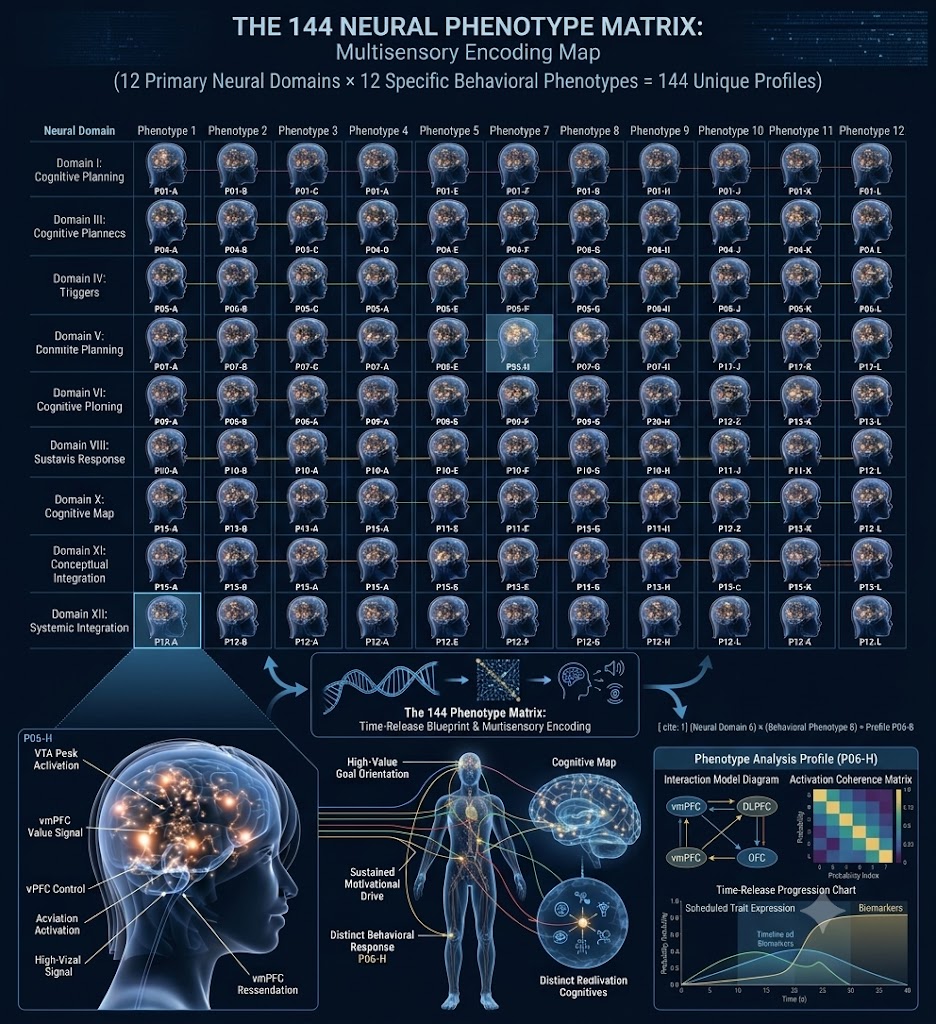
Rather than categorizing symptoms, this approach maps 12 core neural systems across 12 functional life domains, yielding 144 distinct neurocognitive profiles.
This is intended as a functional taxonomy, not a claim of biological finality.
Illustrative phenotype examples:
Why This Matters
- Mechanistic grounding: Links behavioral patterns to neural circuits
- Precision intervention: Targets systems rather than labels
- Dimensional spectrum: Ranges from vulnerability to peak performance
- Comorbidity reframed: Overlapping system dynamics, not multiple disorders
Potential Applications
- Clinical formulation beyond categorical diagnosis
- Research designs testing specific network hypotheses
- Educational strategies aligned with cognitive profiles
- Individual insight into personal neurocognitive architecture
Question for Discussion
Should psychiatry move from categorical diagnosis (you have X) toward dimensional profiling grounded in explicitly defined functional domains?
Example - Domain 5: The Axis of Behavioral Expression
Dopaminergic reward circuits (NAcc/VTA) activate during creative performance, social validation, or pride in a child's success. Premotor action-observation systems amplify vicarious reward and embodied emotional resonance.
I'm sharing the complete reference edition to invite academic feedback and peer discussion, research validation and extension, clinical exploration, and educational use in neuroscience and psychiatry.
The 144 Neural Phenotypes: A Functional Neurobehavioral Taxonomy →
Citation: Syed Hassan. The 144 Neural Phenotypes: A Functional Neurobehavioral Taxonomy for Applied Cognitive and Behavioral Science. GitHub repository, v1.0 (2025).