The Neural Seat of Will: Why the DLPFC Is More Than Executive Control
For decades, neuroscience described the Dorsolateral Prefrontal Cortex as the brain's rational gatekeeper - cold, top-down, in control. That model has been quietly distorting how we understand willpower, decision fatigue, and commitment.
The sequence your brain actually runs
Before the DLPFC engages, four regions have already done the work - Desire fires (VTA/NAcc), Quality is checked (OFC), Options are Weighed (vmPFC), and the Amygdala drops its commit signal to end deliberation. The DLPFC coordinates this sequence. It does not generate the decision.
The DLPFC Is a Governor, Not a Dictator
A ruler with no inputs is not governing.
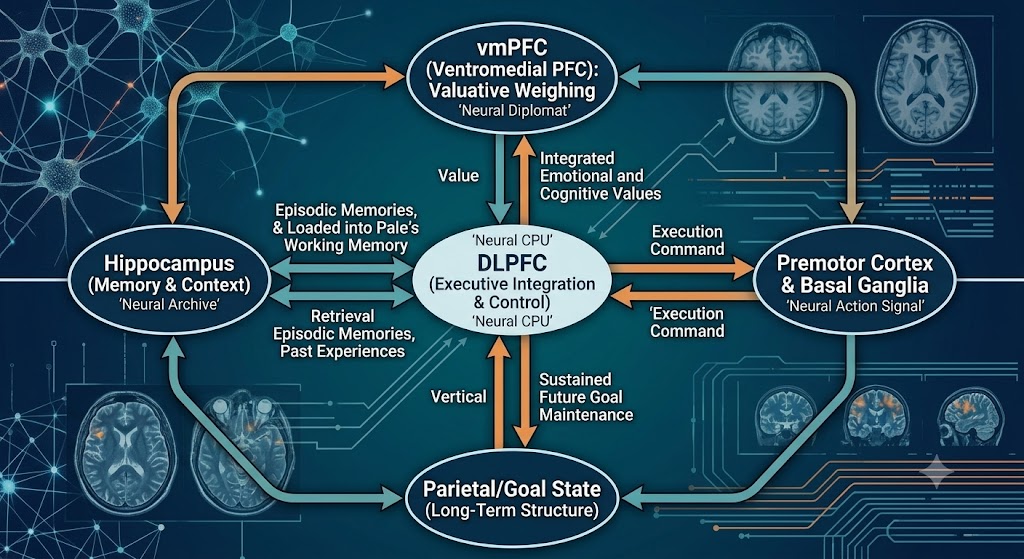
The DLPFC requires four simultaneous inputs: the Hippocampus feeds past experience into working memory, the Parietal/Goal State maintains the future target, the vmPFC delivers the emotional-cognitive value signal, and the Premotor Cortex/Basal Ganglia fire physical execution. Disconnect any one node and the architecture collapses.
Two Intersecting Axes
Time Axis - Hippocampus (past) ↔ Goal State (future). You cannot construct a future without memory feeding it. Damage this pathway and a patient cannot plan for tomorrow because they cannot remember yesterday.
Action Axis - vmPFC (weighing) ↔ Premotor/Basal Ganglia (execution). Once the scales tip, the DLPFC translates the decision into physical momentum. The basal ganglia simply go when instructed.
The DLPFC sits precisely where time and action intersect.
What Lesion Research Confirms
A Journal of Neuroscience study found that DLPFC lesions that spare the posterior cortical system have no effect on working memory. Working memory content is stored in posterior and sensory regions - the DLPFC is a controller, not storehouse.
This means there is no separate working memory system residing in the DLPFC. What neuroscience calls working memory is hippocampal retrieval - the past pole of the time axis - being projected forward toward a goal. The DLPFC coordinates that projection; it does not store the data.
Three peer-reviewed sources confirm this:
- Human Dorsolateral Prefrontal Cortex Is Not Necessary for Spatial Working Memory - Journal of Neuroscience
- Dorsolateral prefrontal contributions to human working memory - PubMed
- Causal evidence for frontal involvement in memory target maintenance - PNAS
Two Decisions. Two Different Loops.
Simple decisions run a fast closed loop: desire, quality check, weighing, commit.
Major decisions - marriage, career, a child - exceed that loop. Neuroscience has documented temporal lobe activation in these moments: deep certainty that bypasses prefrontal deliberation and lands on the amygdala - not as fear, but as peace. Every wisdom tradition has a name for this. The neural substrate is measurable.
The Neural Address of Will
Philosophers from Aristotle to Kant have debated the nature of will for millennia. The debate stayed abstract because it lacked coordinates.
Will requires all four inputs simultaneously:
- Memory to draw from (past)
- A goal to aim toward (future)
- Options to weigh (evaluation)
- The capacity to act - to Fire (execution)
While mainstream science treats the DLPFC rigidly as just the final structural executor, my model argues that "will" cannot turn a thought into reality unless the brain cycles through all four of these distinct stages.
While the system operates simultaneously, the entry point of focus shifts depending on the real-world scenario:
- Having a Child (Starts with Initiation): Passionately deciding it is time to start a family (Initiation) - Weighing financial readiness and career trade-offs together (Balance) - Recalling your own upbringing to choose a parenting style (Memory) - Sticking to the timeline and preparing the nursery (Structure).
- Buying a House (Starts with Memory): Evaluating your current cramped living situation and past rental history (Memory) - Making the definitive choice to stop renting and buy (Initiation) - Comparing mortgage rates and budget limits (Balance) - Executing the down payment and move (Structure).
- Marriage (Starts with Balance): Dating and assessing long-term compatibility (Balance) - Popping the question and committing to partnership (Initiation) - Merging two different family traditions (Memory) - Planning the logistics of building a life together (Structure).
Will is the capacity to take what you know, project it toward a future goal, weigh the options, and fire - with all four integrated at once.
The DLPFC is not the seat of executive function. It is the neural address of will itself.